Spain’s Supreme Court clarifies when a self-employed transport worker may be classified as an employee
26-10-2026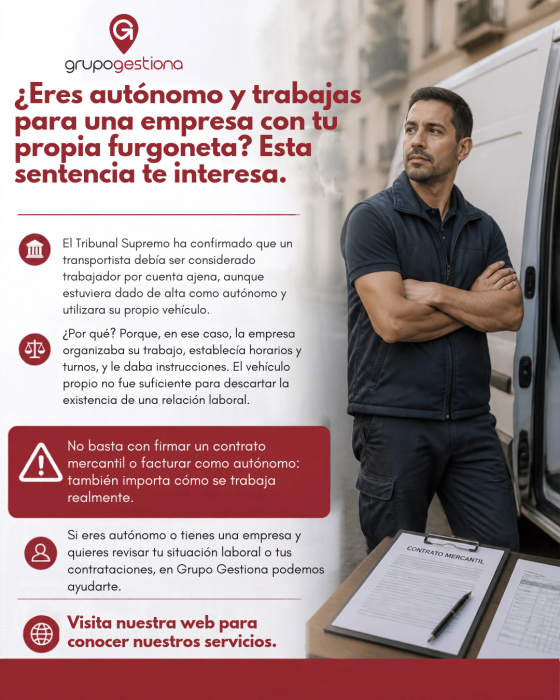
Spain’s Supreme Court has confirmed that the relationship between a company and a transport worker who had provided services for years using his own van was an employment relationship. The judgment, dated 15 September 2026, highlights that being registered as self-employed, issuing invoices or using a personally owned vehicle does not, by itself, establish that a relationship is commercial rather than employment-based.
In the case examined, the worker transported materials within a factory’s premises and carried out most of his journeys inside a private industrial site. Although he used his own van, the company organised his work, set his working hours and shifts, gave him instructions and coordinated his holidays. He was also paid according to the time worked.
The Court considered these circumstances indicative of an employment relationship and ruled that providing his own vehicle was not enough to exclude that classification. It therefore upheld the decision recognising the employment relationship and returned the case to the lower court to rule on the dismissal.
What does this mean for self-employed professionals and businesses? The judgment highlights the importance of examining how a working relationship operates in practice. The legal nature of an arrangement does not depend solely on the contract’s title, but also on factors such as work organisation, instructions, schedules and the professional’s actual independence.
The ruling does not mean that working for a single client automatically makes a self-employed person an employee. Each situation must be assessed according to its specific circumstances and the applicable law.
At Grupo Gestiona, we help self-employed professionals and businesses manage their administrative and employment-related obligations and address questions about their business activities. If you need guidance for your business, contact our team.
